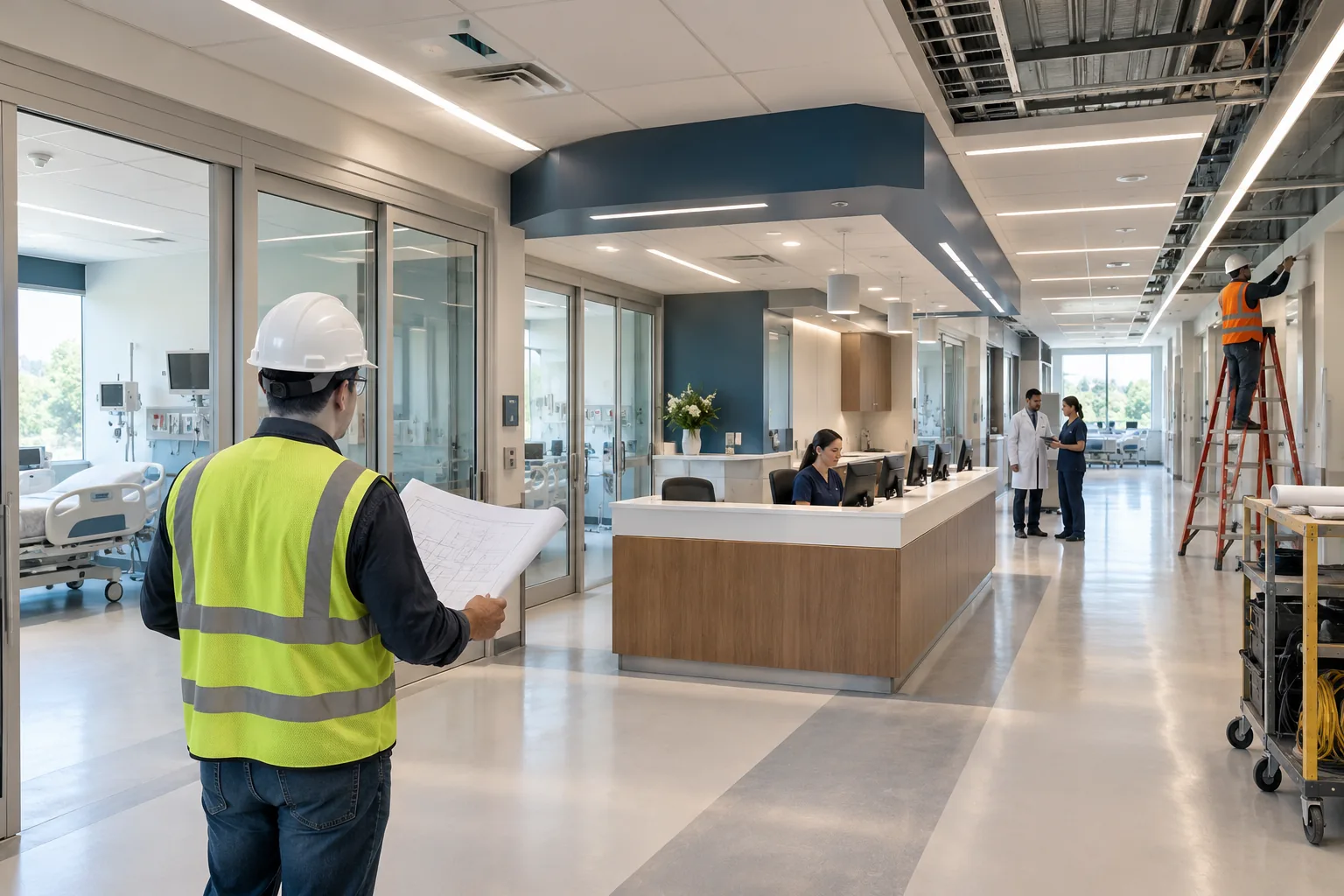
Documents and inputs
- Current scope documents and project program
- Material, labor and equipment rate assumptions
- Schedule, procurement and location context
Cost estimating translates a defined scope into a structured view of expected direct and indirect project costs.

Cost estimating translates a defined scope into a structured view of expected direct and indirect project costs.
Review the latest documents and define the requested estimating scope before pricing. The checklist below identifies typical inputs, quantities and coordination issues; it is not a claim that every project or trade is available.
DISCUSS YOUR PROJECT ↗Specific information to help define the work package and avoid missed scope.
A simplified worksheet showing how measurement records can be organized. No quantities or completed client project are represented.
| Work item / review category | Measurement basis | Drawing reference | Review note |
|---|---|---|---|
| Cost categories by trade or work package | Confirm unit from plans | Verify issued sheet / schedule | Validate unit rates against project conditions |
| Allowances, contingencies and escalation assumptions | Confirm unit from plans | Verify issued sheet / schedule | Separate direct costs from overhead and markup |
| Basis-of-estimate notes | Confirm unit from plans | Verify issued sheet / schedule | Flag items without enough design information |
Each work item needs a drawing reference, appropriate unit and documented scope check. This visual is illustrative, not a client drawing.
See illustrative deliverable format →Illustrative format only — actual quantities, prices and document references require project drawings.
Check current plans, specifications, schedules and addenda.
Organize units and references by work item.
Check interfaces, exclusions and unanswered questions.
Reconcile quantities and document the review basis.
Measurement principles, scope boundaries and review considerations specific to this topic.
Commercial cost estimating converts a documented scope into a cost structure using project-specific quantity, labor, material, equipment and indirect-cost assumptions.
Best suited to: Teams comparing project costs against a defined scope. Confirm the project drawings, deliverables and service availability before requesting a proposal.
Confirm the estimating objective and design maturity before starting. Gather current scope documents and project program; material, labor and equipment rate assumptions; schedule, procurement and location context. Record drawing issue dates and identify whether the request is a conceptual budget, measured quantity schedule or bid-oriented estimate.
Create a work breakdown aligned to cost categories by trade or work package; allowances, contingencies and escalation assumptions; basis-of-estimate notes. Each line should identify its source document, unit, assumption and review status. Missing scope should be flagged as a clarification, not hidden inside a fabricated allowance.
Separate measured quantity from pricing. A quantity takeoff establishes the measurable work; a cost estimate additionally needs verified unit rates, labor assumptions, equipment and subcontractor quotations. Record exclusions and contingency independently so the total can be traced to its inputs.
A review should check validate unit rates against project conditions; separate direct costs from overhead and markup; flag items without enough design information. Revisit the estimate after each addendum because revised plans can change both quantities and scope ownership.
Illustrative arithmetic only: 240 SF of a specified assembly at an assumed $18/SF produces $4,320 in direct assembly cost (240 × 18). The $18 rate is hypothetical and excludes labor adjustments, taxes, indirect costs, contingency and profit unless explicitly included. Do not use this example as a commercial quote.
Ask for an itemized quantity register, drawing references, assumptions, exclusions, allowance schedule and a list of unresolved design questions. Check whether the expected output is cost categories by trade or work package, allowances, contingencies and escalation assumptions, basis-of-estimate notes.
An estimate supports a decision; it does not guarantee an awarded bid, a final contract price or professional engineering certification. Confirm responsibilities and obtain current project-specific market pricing before submission.
Cost estimating needs a documented basis for labor, material, equipment, subcontract and indirect costs, rather than quantities alone.
Illustrative cost structure: $12,000 direct materials plus $8,000 direct labor equals $20,000 direct cost. If a hypothetical $2,000 equipment allowance is added, the subtotal is $22,000 before overhead, contingency, tax and profit. These are invented arithmetic inputs, not market prices.
Project categories illustrate different drawing packages and estimating considerations; they are not a completed-project portfolio.
Share the latest issued drawings, specifications, relevant schedules and addenda. Include the project location, design stage and requested deadline; missing documents should be recorded as open questions.
The review may cover cost categories by trade or work package, allowances, contingencies and escalation assumptions, basis-of-estimate notes. Final inclusions, exclusions, measurement units and deliverables must be confirmed for the specific project.
Quantities should be traced to drawing references, measured in the appropriate units, reconciled against schedules and checked for overlapping work packages and revisions.
No. The examples are educational. Project-specific rates, deliverables, availability and timelines require a separate scope review.
Tell us about your project, drawings and bid date. This is an inquiry, not a confirmed quote or commitment.
A preliminary cost estimate is not a guaranteed contract price.
Educational examples do not represent completed client projects, confirmed availability or guaranteed results.